
Key Takeaways
- Keep inherited coins with their existing holders, albums, and any accompanying records.
- You do not need to clean or reorder the collection first. Grouping like items together helps; separating every single date does not.
- An old receipt or handwritten price is useful background, but it does not establish what a coin is worth today.
- If you are settling an estate, know the difference between a free purchase evaluation and a written appraisal before you make the appointment.
- Understanding the collection can come before deciding which coins to keep or sell.
“My dad passed in March. There’s a closet full of albums and binders and boxes of coins, and I have no idea what any of it is.”
We get some version of that call most weeks, and I thought it was worth writing about, because the person making it is almost always apologizing for something they don’t need to apologize for. They didn’t collect it. They didn’t sort it. They don’t know what all they have. They aren’t sure if it’s worth anything at all. None of that is a problem. The only thing that regularly costs families time and money is what happens before they call — the well-meant tidying up.
You may recognize the handwriting on a coin envelope long before you recognize the coin inside it. Someone took the time to write down a date, a price, or where the coin came from. If you have inherited the collection, keep that note with the coin. Or, there may be no notes at all.
You do not have to make sense of every coin before contacting us. Leaving the collection together gives us a starting point, and it gives you time to decide what you want to do with it.
If there are records, keep them with the coins they describe
An album may show the set someone was building. An envelope may identify a date and mint mark. A receipt may help connect a purchase to a particular coin. These details can provide context even when the person who assembled the collection is no longer available to explain it.
If you find records, keep them nearby:
- Leave handwritten envelopes with the coins they refer to.
- Keep purchase receipts and previous appraisals, if they exist.
- Preserve grading labels and certificates with their matching holders or packaging.
- Keep family notes or a written inventory with the collection.
There is no need to create missing paperwork. If the coins arrived in a box with no labels at all, we can help you determine what you have and what it might be worth.
A label is also something to verify. A handwritten identification may be incomplete, and a price paid years ago may bear little resemblance to today’s market — in either direction. I’ve seen a 1974 receipt for $180 attached to a coin worth a small fraction of that in real terms, and I’ve seen a $40 note pinned to a coin that brought several thousand. We examine the coin itself before assigning a value.
If an old appraisal turns up, hold onto it even if the numbers look stale. For estate purposes, a prior appraisal sometimes matters less for its figures than for establishing that the collection existed and what was in it.
Leave holders and albums intact
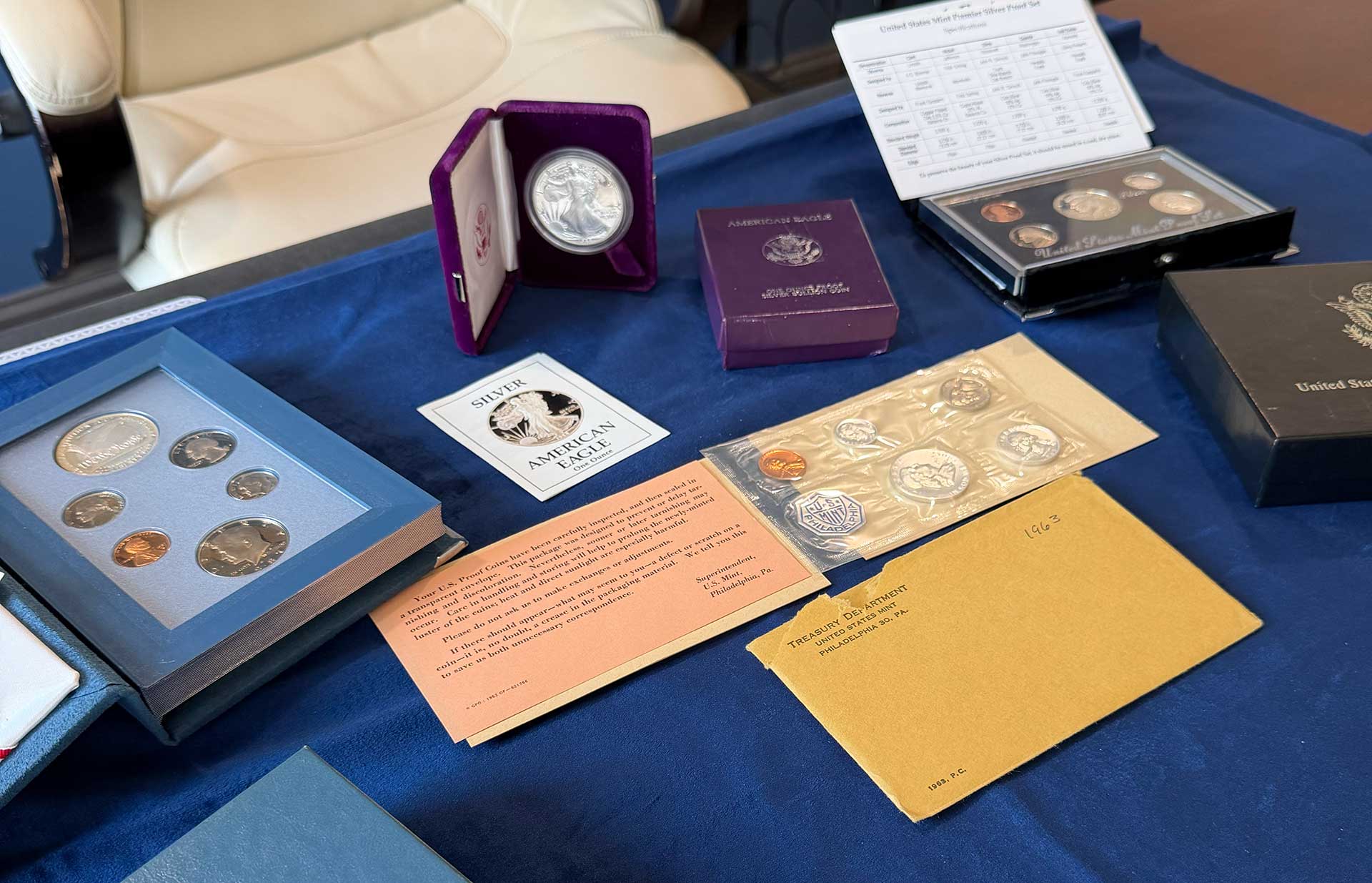
You do not need to remove coins from albums, open sealed grading-service holders, or combine everything into a bag to make it easier to carry.
Keeping the existing arrangement can help preserve both the coins and the information around them. It also avoids unnecessary handling while you are learning what you have.
Some folks see old coins and are tempted to “clean them up”. Let me be straight about the cleaning question, because it comes up every single time and the answer disappoints people: don’t. A coin with original surfaces and honest wear is worth more than the same coin polished bright. Not a little more — sometimes several times more. The instinct to make something look nice before showing it to a professional is a good instinct in almost every other area of life. In coins it is the single most costly thing a family can do between the funeral and the appointment.
If a holder is broken or you see residue on a coin, mention that when you contact us. Ask before attempting to remove the coin or clean the surface.
Our article on how coin value is determined explains why condition matters alongside rarity, metal content, and demand.
You do not have to sort the collection first
Some people enjoy looking through every date. Others would rather have someone explain the collection with them. Either approach is fine.
If you want to do something useful before the appointment, group like items together — silver dollars with silver dollars, half dollars with halves, dimes with dimes, proof sets with proof sets, anything in a graded holder set aside on its own. Bagging or boxing those groups is genuinely helpful. It speeds up the appointment and makes it easier for us to walk you through the collection in a way that makes sense.
What I’d ask you not to do is separate every individual date. I’ve had people spend weeks sorting a coffee can of silver into labeled envelopes by year and mint mark, only for us to pour most of it back together in a single pile, because the coins were common-date silver valued for their metal content. That’s weeks of somebody’s evenings that didn’t change the number by a dollar. If I can save one person from that, this whole post was worth writing.
Now — if you want to go through it coin by coin, go right ahead. Some people find that genuinely enjoyable, and it’s often the closest thing they’ll get to sitting down with the person who built the collection. Others want to look for key dates, which is a reasonable thing to want to do with your own family’s coins before anyone else sees them. Either is a fine reason. Just do it because you want to, not because you think we need it.
Our free Rare Coin Guide is the right tool for that. It shows you which dates and mint marks are worth pulling out and which ones aren’t, so you spend your time where it actually matters. Request a copy and it’s yours — no cost, no obligation.
The collection might include common silver coins valued largely for their metal, coins sought by collectors for a particular issue or condition, or a mixture of both. Those qualities can overlap — a silver coin can also have collector value. You do not need to decide which category applies before an appointment. We can identify the coins and explain the differences as we go.
If you are the executor, a few things are worth knowing early
Settling an estate is different from deciding what to do with a keepsake. There’s a timeline, there are other people counting on you, and there may be a court or a CPA who wants a number.
A few things I’d tell any executor sitting on a coin collection:
Establish what you have before anyone starts dividing it. Coins are easy to move and hard to inventory after the fact. An evaluation early in the process protects you as much as it informs the heirs.
Tell us up front that this is an estate. That changes what we produce for you. A verbal walkthrough is fine for a family deciding whether to keep Grandpa’s Mercury dimes. It is not fine for a probate filing.
Coins are often the last thing anyone gets to. They sit in a bank box for two or three years while the house and the vehicles get handled. That’s understandable, but the metal markets move, and so does the collector market. Waiting isn’t a strategy. We can help resolve estate collections much more quickly and easily than people think.
Be careful who handles them. I’ll say this as fairly as I can: most estate sale companies and general auctioneers are honest, hardworking people, and I’ve worked alongside several I’d recommend without hesitation. But coins are a specialty. A collection that gets lotted out as “box of old coins” at a general sale can leave real money on the table that nobody — not the seller, not the buyer, not the auctioneer — ever knew was there. If coins are a meaningful part of the estate, have someone look at them who does this every day.
For larger collections, a safe deposit box, or a situation where moving everything isn’t practical, we can make arrangements to come to you rather than asking you to transport it. Call and we’ll work it out.
And when a family wants the whole thing resolved in one transaction, we buy estate collections outright — all of it, not just the pieces we’d most like to own. Cherry-picking the good material and leaving a family holding the rest is not how we want to do business.
When more than one person has a claim on it
Two heirs, one collection, and no instructions is a common situation and an uncomfortable one.
An independent evaluation helps here in a way that has nothing to do with buying or selling. It gives everyone the same set of facts. Once you know what the Morgan dollars and the proof sets are worth, the conversation stops being an argument about value and becomes a conversation about what people actually want.
We’re glad to walk more than one family member through the collection at the same appointment, or to provide written documentation the family can divide from. We don’t take sides, and we don’t need to know how you settle it.
Tell us what the collection means to you
When I was a child, my father showed me an 1897 $20 gold coin. I remember wanting to own a coin like it one day. A coin can stay with you in that way, long before you know anything about its market value.
If a particular coin reminds you of the person who left it, that belongs in the conversation. An appraisal can explain what someone might pay for the coin. It cannot decide what keeping that connection means to your family.
I’ve told people to keep coins we would have been happy to buy. That’s not salesmanship — it’s that the twenty-some-odd dollars of silver in a Walking Liberty Half Dollar is not what makes it worth keeping when it was your grandfather’s.
You can tell us that you are considering a sale, that you want to keep the collection, or that you have not decided. Learning what you have does not require making every decision at once.
Let us know what kind of evaluation you need
A basic offer-to-purchase evaluation and a formal written appraisal are two different services.
Our basic evaluation is free and carries no obligation to sell. We look at what you brought, tell you what it is, and tell you what we’d pay for it. You can walk out with that information and do nothing with it.
A written appraisal is a paid service — currently $125 per hour — because it’s a different kind of work. It’s a documented, itemized valuation prepared for a purpose: probate, estate tax, insurance, or an equitable division among heirs. If your attorney, CPA, or insurance carrier has asked for something in writing, this is what they mean.
Tell us which one you need when you call so we can talk through the scope and the cost before you drive over. If you’re not sure which one your situation calls for, say so — that’s a two-minute phone conversation that can save a lot of time later on.
Our coin appraisal page explains those options in more detail. If you later choose to sell, the guide to selling silver coins in Nashville covers what to consider at that stage, and we publish our minimum buy prices at NashvilleGoldStore.com/What-we-pay so you can see our numbers before you ever contact us.
One note on credentials, since this post touches on estates: I am a precious metals dealer and a coin dealer. I am not an attorney, a CPA, or a financial advisor, and nothing here is legal or tax advice. What I can tell you is exactly what the coins are and what they’re worth. For how that fits into the estate, talk to the professional handling it — and we’re happy to give them what they need from us.
Bring the collection as it is
We work by appointment at our Nashville office, and same-day appointments are often available. When you contact Nashville Gold and Coin, tell us roughly what you have, even if your description is simply “a few albums” or “several boxes my mother kept in the closet.” That gives us a starting point for planning the visit.
Pictures are incredibly helpful, email them to sales@nashvillegoldandcoin.com and we’ll give you an idea of what you’re working with before you make the trip.
Everything we do is one-on-one, private, and unhurried. No high-pressure tactics, no gimmicks. If you decide to keep every coin, we’ll have had a good conversation and you’ll know what your family has.
Whenever you feel ready, bring the collection and the questions that came with it. We can help you understand what you have while you take the time to decide what to keep.
Call 615-535-2785 or text 615-626-5435 to arrange an appointment. Thank you for reading — we look forward to hearing from you soon.